Tokens aren't Alpha

AI dramatically reduced the cost of building software. The bottleneck moved, and most companies haven’t moved with it.
An exec friend told me recently: "My team says AI makes them way faster. But my P&L looks roughly the same."
Right now, most of the gains from AI go to employees, not the company. People finish their work by 2pm. Busywork gets done faster. Each person feels more productive. But the company isn't making better decisions, and margin and growth look the same as last year.
The tokens are flowing. The alpha isn't.
I think the reason is that the bottleneck moved, and most companies' operating models haven't moved with it—yet.
The most expensive step just got cheap
Think of the path from intelligence to outcome as a supply chain. I call it IQ to Alpha:
- Figure out what to do
- Build the system that does it
- Run it
- Learn from it
For teams whose work happens primarily in software, step 2 has been the bottleneck for decades. Building useful software took months and a team of engineers, PMs and designers. Today one or two people can build something useful in days.
Anyone who has run operations knows what happens next. When the most expensive link in a supply chain gets cheap, the constraint moves.
Software engineers are already living this. They're becoming managers of software factories, spending less time writing code and more time writing specs and reviewing output. Energy in software development has shifted to both ends of the process:
- The start: saying what you want, and what good looks like.
- The end: checking that what you got is correct and safe, and keeping a record of what you learned.
The same shift is coming to operations. The hard part becomes saying what good looks like, then checking whether you got it.
Why code and math took off first
One reason AI has made huge leaps in coding and math is that much of the work can be checked. Code passes its tests or it doesn't. A proof holds or it doesn't. So a model can try, get feedback and try again thousands of times, and it improves fast.
Most operations don't have explicit, reliable ways to grade decisions. Ask ten people at a company what a good pricing decision looks like and you'll get ten different answers, or none. Without a clear answer there's no feedback, and without feedback nothing learns.
AI gets good at whatever you can grade. Most companies have never written down the grade.
From a line to a loop
I'm focused here on operations where the decisions and actions happen primarily in software: processing invoices, handling support queues, setting prices, allocating ad spend and planning inventory. Physical execution—moving goods, running a factory, doing work in the field—is outside the scope of this piece.
Most of them are designed as a line. Work comes in, work goes out, and people are measured on how fast and accurately they move it from A to B. Each run looks like the last one. Every so often someone runs a kaizen project.
The alternative is a loop, where every run makes the next run better.
This is where employee surplus turns into company alpha. When AI speeds up a person in a line, the gain stays with that person. When it runs in a loop, the gain compounds for the company.
I've seen this work. At Opendoor, an algorithm priced our offers on homes, and our pricing ops team reviewed the hard cases. Each time someone overrode the algorithm, the override became a label the model learned from. Each home we sold told us whether we'd priced it right. Square's fraud system worked the same way: every call an analyst made on a flagged transaction became training data for the next model. Both systems improved over time because we designed them to learn.
A human override captures judgment, not necessarily the right answer. The loop needs both that judgment and the eventual outcome. Then it needs a way to test whether a change actually improves decisions before putting it into production.
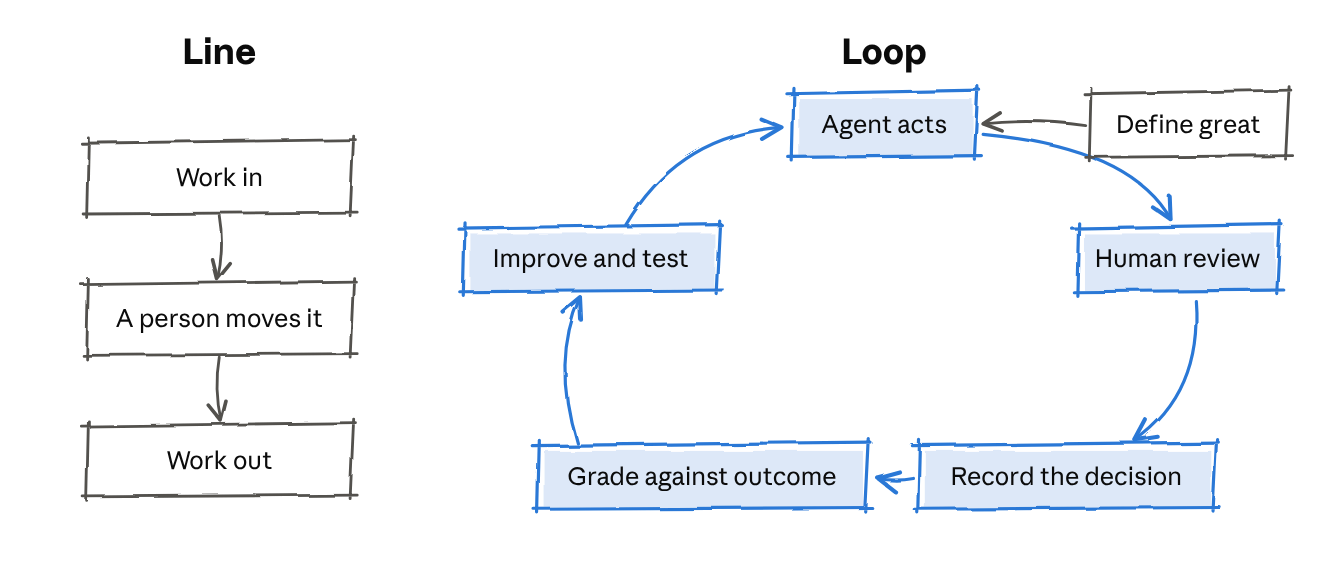
The new default:
- Agents do the work.
- Humans stay accountable.
- Humans teach. They set the standard and handle the hard cases, and corrections become feedback the agent can learn from.
- The tools make that easy.
This includes critical decisions. How should we split ad spend across campaigns and across platforms? How should we price and promote this inventory? Defining what a good decision looks like is the starting point. Agents also need the right context, clear limits and a way to check outcomes before earning more autonomy.
A quick test for any process:
- Can you write down what great looks like?
- Do you measure every run against it?
- When a human corrects the work, is that correction saved as data?
- Do you test and use what you learn to improve future runs?
Four "no"s means you have a line. Most companies have lines everywhere.
Change (the) management
People like to say AI adoption is a change management problem: employees resist the new tools.
I'd argue the biggest change has to happen at the management level. Change management, indeed.
It starts with being clear about what great looks like (clear is kind). Making operations checkable is a leadership job; you can't hand it to the frontline and hope.
Incidentally, I suspect the COO of the future will be judged on how good a training ground they build for their agents. That means a working model of how the business runs, with every dial and lever exposed, so agents can tune the business themselves. (Chief RL Officer?)
Here are some things that are table-stakes for Ops leaders:
- Write down the grade. Pick one critical decision and define what great looks like, in a way you can measure.
- Turn one line into a loop. Record every override and every outcome, and use both to improve the next run.
- Open up the tools. Let the tokens flow. Then have each operator ship one improvement to their own agent. Just do it.
- Push from the top, the bottom and the middle at once. We're in a massive techno-economic wave. People will come out the other side more employable, or less.
Get on the curve
The AI world loves to dunk on benchmarks. Meanwhile, most companies on earth haven't defined theirs.
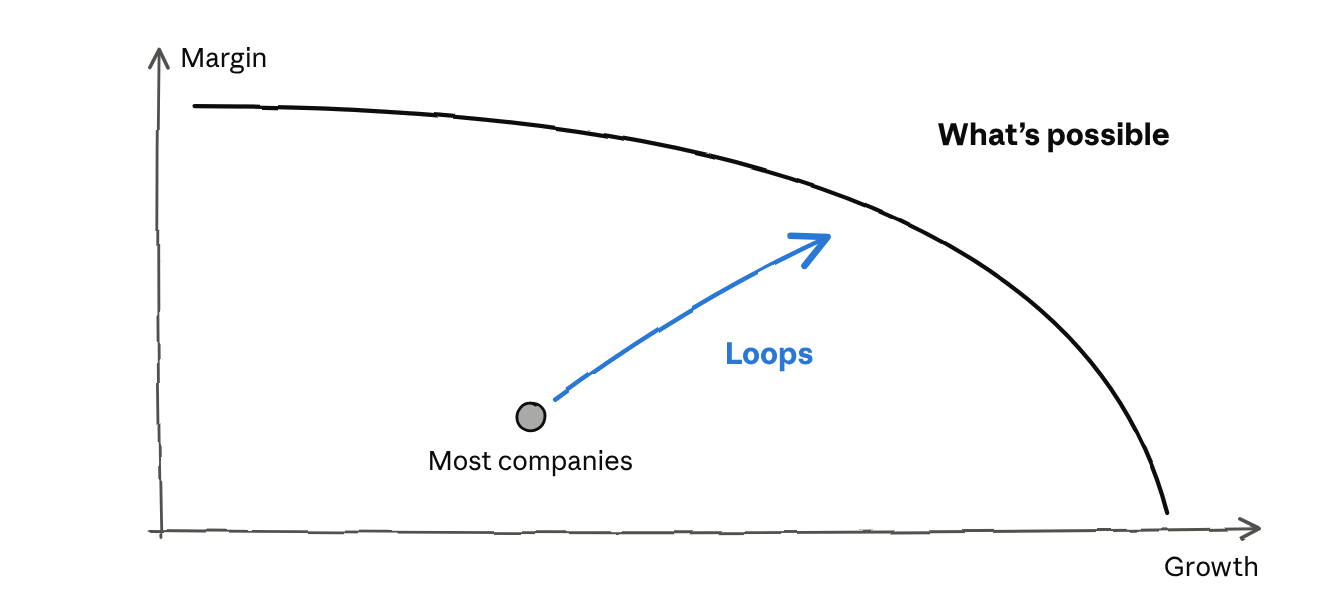
Ask a leadership team: with the way you make decisions today, what's the trade-off between growth and margin? And how far are you from the best trade-off you could get?
Almost no one can answer. Most companies don't know where they sit relative to what's possible.
Once you digitize your operations, define what good looks like, build loops and form a working theory of how your business runs, you can draw that curve. Then you can start climbing it.
The upshot
AI made the most expensive step in IQ to Alpha cheap. The gains show up in the P&L when a company redesigns how it operates, so decisions generate feedback that improves future decisions. Until then, tokens aren't alpha.
